Houston Unhoused
1. About this project
This is a project for the Media Innovation Group at the University of Texas at Austin in collaboration with Houston Public Media.
John Whitmire became Houston mayor in January 2024, promising to end street homelessness during his term. Our data analysis supports Dominic Walsh’s reporting to investigate Whitmire’s approach so far. Read the published works here and here.
Primary data analysis is by senior journalism student Layla Dajani and edited by Christian McDonald, associate professor of practice and director for the Dallas Morning News Journalism Innovation endowment.
2. About the data
We analyzed Houston municipal court data showing citations given to unhoused people in downtown Houston. The data ranges from Jan. 1, 2016 to Jan. 15, 2026, and includes columns detailing defendant information, offense date, offense location, court judgment date, fine information and violation description. To map offense locations, addresses are geocoded using geocod.io. OpenRefine was also used to cluster people with misspelled or varied names.
This analysis will often compare numbers and underline differences before and after January 2024, when Whitmire’s term began.
There are 11 types of violations that have been given since 2016, all of which can be categorized into a sidewalk obstruction ordinance, civility ordinance or other. There are also eight new violation types that were only introduced in 2025, three of which are sidewalk obstructions, four are civility ordinances and the final one is other. See a more detailed breakdown of each violation code in section 3 of the analysis notebook.
2. Limitations and considerations
- OpenRefine was used to cluster misspelled and varied names. Each decision was made manually based on calculated judgment calls, which may portray people with more/less citations than they actually received. It may also impact how many individual people are estimated to have received citations. See section 5.2 of the cleaning notebook for more details on what OpenRefine was used for.
- Some citations have duplicate case numbers because the second appearance tracks how the case developed. So to confidently know that each row does represent an individual citation, an object that does not have duplicate rows is created in section 1 of the analysis notebook. In that object, the second appearance of each case is kept because that provides the most updated data.
- Cases from recent months are yet to receive a judgment. Therefore, recent months may not be representative of judgment statistics.
3. Visualizations
Find interactive versions of each visualization in the analysis notebook. Interactive versions offer details for specific points or elements on a chart. For instance:
- Hover the mouse over data points to view more details about it.
- Left click and drag the mouse to select particular parts of a visualization to expand that section.
- Select and deselect elements from the legend to view or hide parts of the chart.
3.1 Citation counts over time
Between July 2023 (six months before Whitmire’s term began) and November 2025, October 2025 had the highest citation count in that date range, at 492 that month. Leading up to that, the monthly citation count from May to October indicates an incline. Looking back even further, October 2025 had the highest citation count in over four years.
However, to put that in the larger context, October 2025 only reached 61.7% of the January 2021 citation count, which is the highest citation month in this data set.
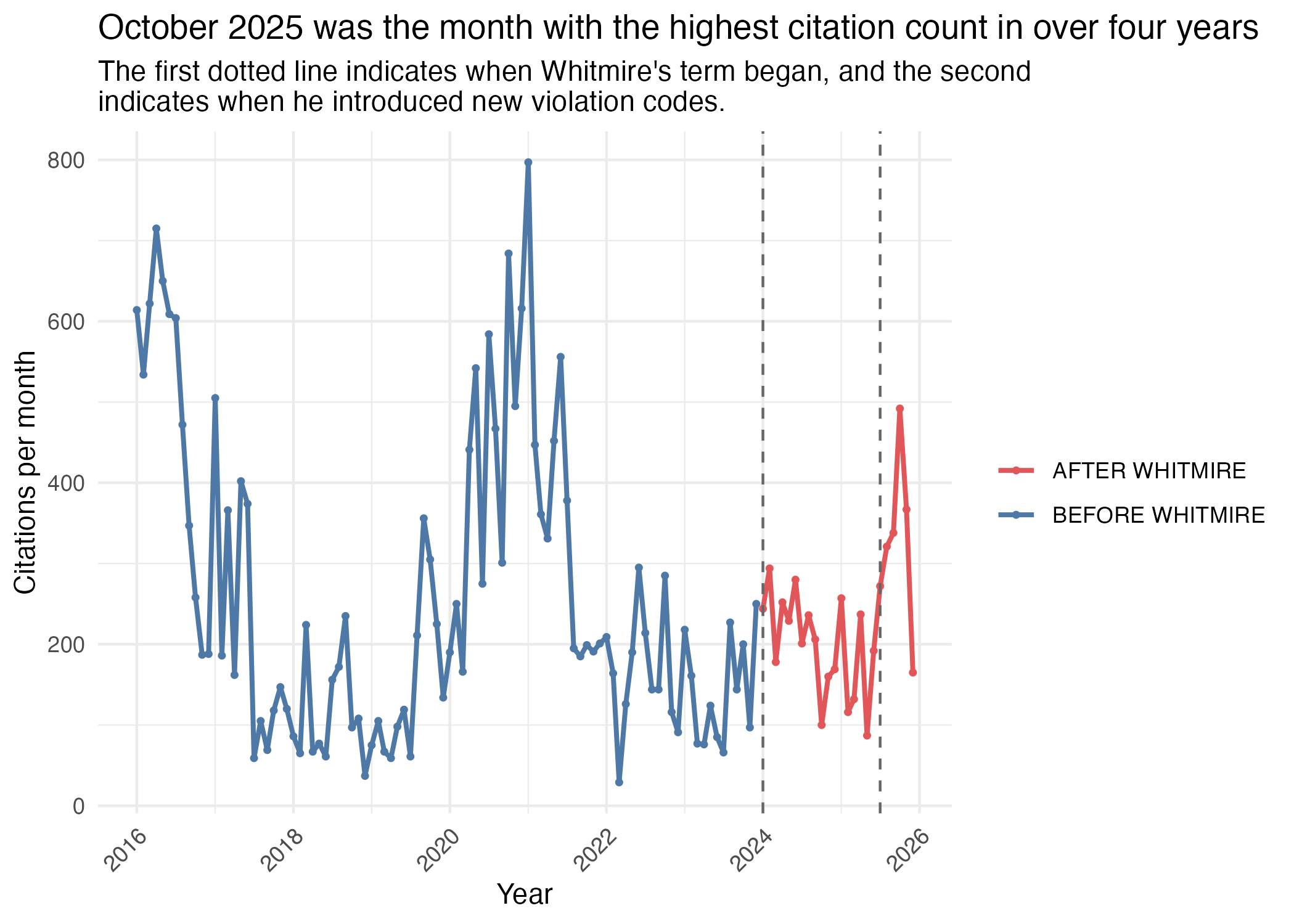
See more about citation counts over time in section 2 of the analysis notebook.
3.2 Violations types
There are 11 types of violation codes that have been given since 2016:
- CC753: selling goods in public area
- CC921: a sidewalk obstruction ordinance
- CC940: person obstructing sidewalk by sitting/laying down between 7 a.m. and 11 p.m.
- CC941: obstructing sidewalk with bed mat or personal possessions between 7 a.m. and 11 p.m.
- CC942: impair or obstruct sidewalk without a permit
- CC943: impair or obstruct sidewalk beyond scope of permit
- CC948: place or allow obstruction on sidewalk
- CC956: a street vendor ordinance
- CC2043: expanded civility ordinance at any time for sitting or lying down on the sidewalk
- CC2044: expanded civility ordinance at any time or place for placing personal posessions on the sidewalk.
- CC20245: civility ordinance at any time for sitting or lying down on the sidewalk in an area subject to rules and regulations for enforcement.
CC940 and CC941 monthly citation numbers follow similar trends through this data set (analysis 3.3.1.2), suggesting they have been given out at similar rates. They are also the most frequent violation codes in this data set (analysis 3.1). But starting around July 2025, when Whitmire introduced new ordinances, there became less CC941 citations relative to CC940 numbers, while new violation code counts increased. In December 2025, one of the new violations, CC942, surpassed CC940 by two citations.
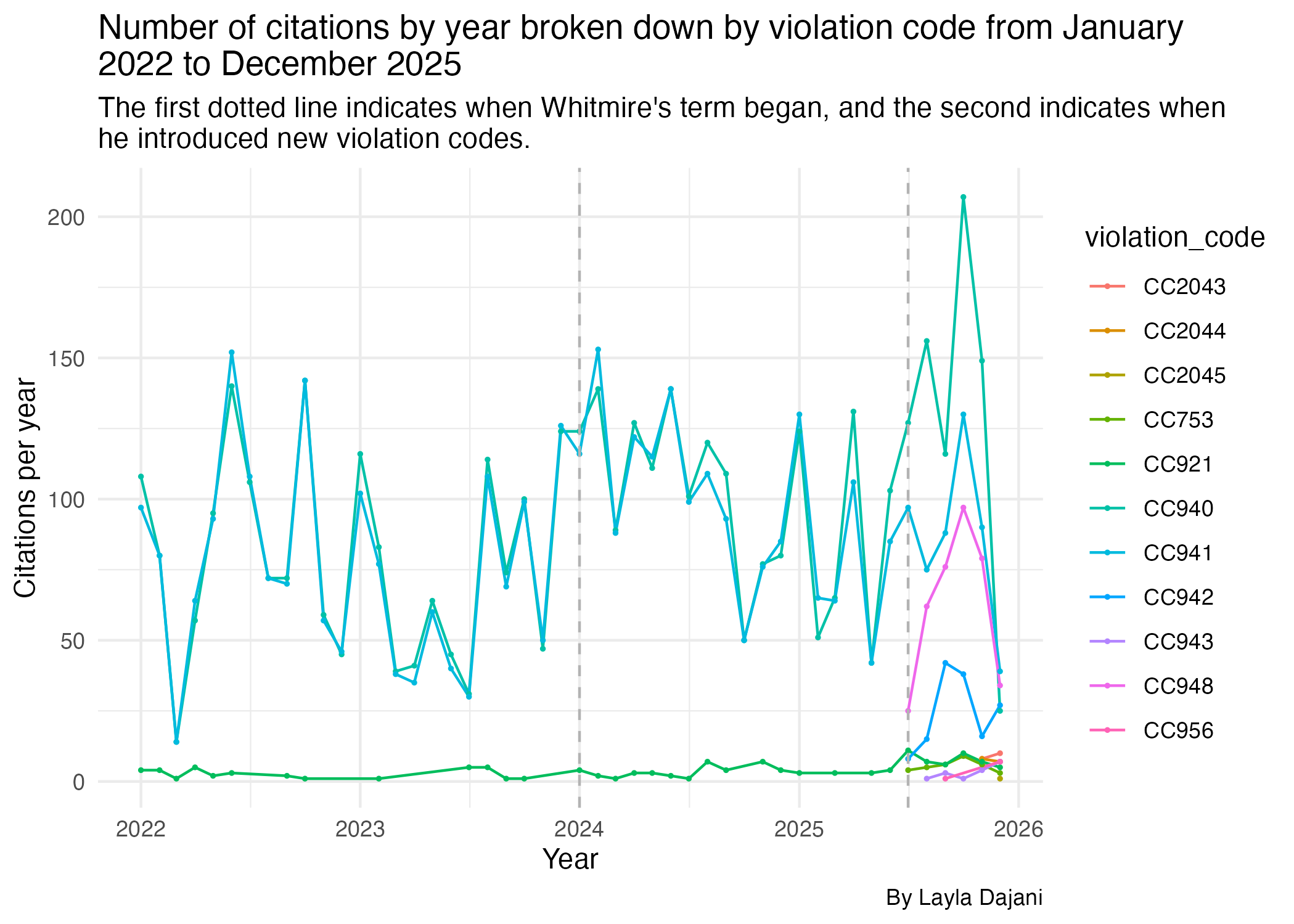
This is further displayed in analysis 3.3.3.2.
Following Whitmire’s introduction of new sidewalk obstruction ordinances in July 2025, October 2025 had the highest sidewalk obstruction citations per month in this data set. The 146 citations made up around 38% of all citations given that month.
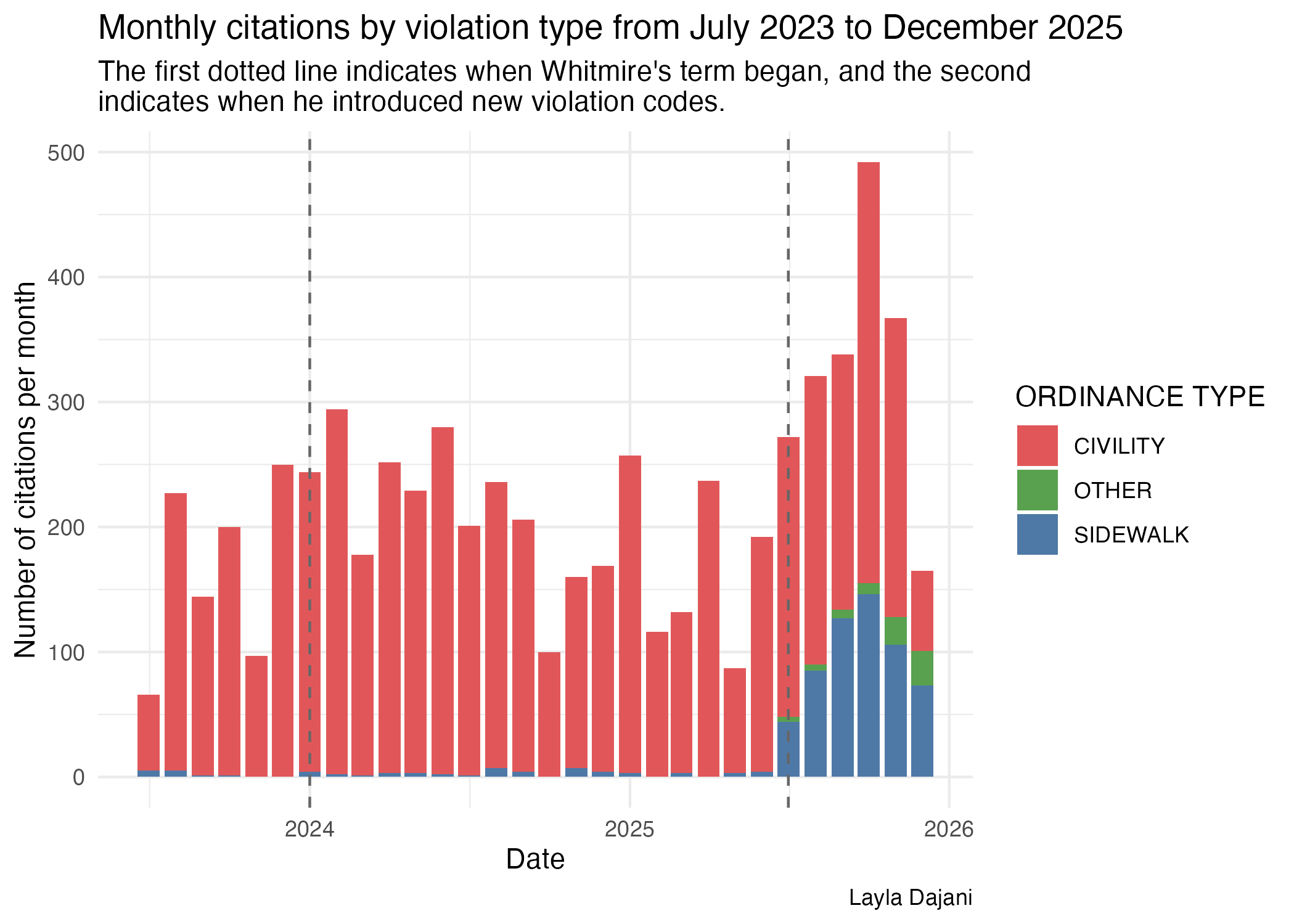
See more about violation codes in section 3 of the analysis notebook.
3.3 Patricia Norris
Of all the estimated distinct people in this data set, Patricia Norris has been charged the highest total fines at around $199,123. She hasn’t paid any of her fines, but has had about $149,118 dismissed, which leaves about $50,006 that she still owes.
In the chart below, each one of the points is a day, so the higher her citation count on the chart, the more citations she received in a single day. Almost every time Patricia Norris has been given a citation, she has also been given at least one other citation. She was also hit with citations almost consistently from January 2020 to May 2025.
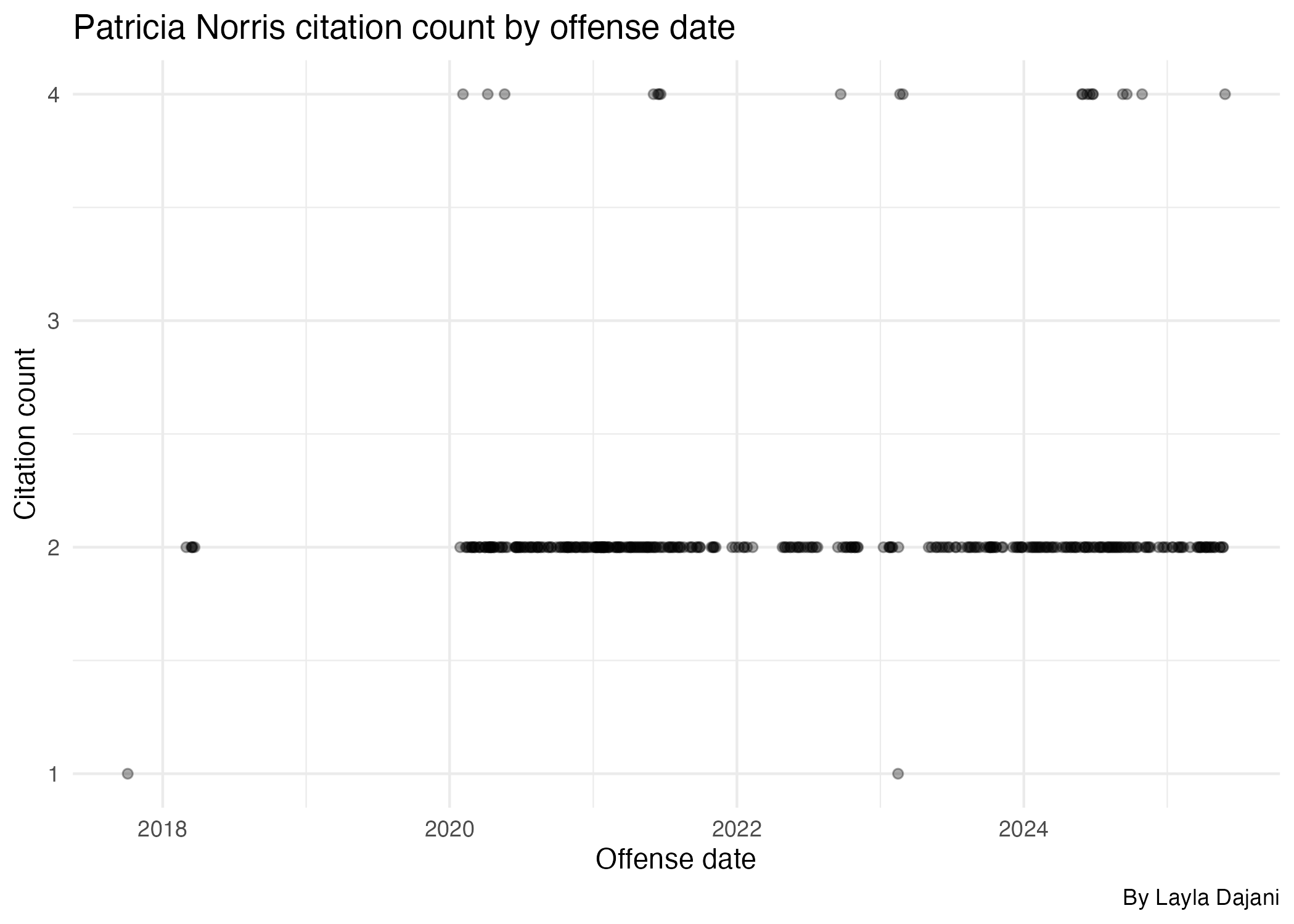
See more about Norris in section 8.2 of the analysis notebook.
4. Also of interest
- See 4.1.4 for a breakdown of common judgments, and 4.2.1 for a breakdown of dispositions.
- See 5.1.1 for how many distinct people have received citations in this data set.
- See 5.2.1 for who has received the most citations in this data set.
- See 5.3.1 for the names of people who were most fined and who paid off the most fines.
- 5.3 has a searchable chart for further information about each person in this data set, including how many citations each person received.
- See 6.6 for a general breakdown of fine distributions.
- See 9.2 for a breakdown of citations per zone, including charts that show zone distributions by month and year.