MIG Maternal Health Project
Maternal Health Project
This project supports reporting by Monique Welch-Rutherford for a story about maternal health in Houston area hospitals published by Capital B News. You can read her reporting here: This Texas County Is the Deadliest Place in the U.S. for Black Mothers to Give Birth.
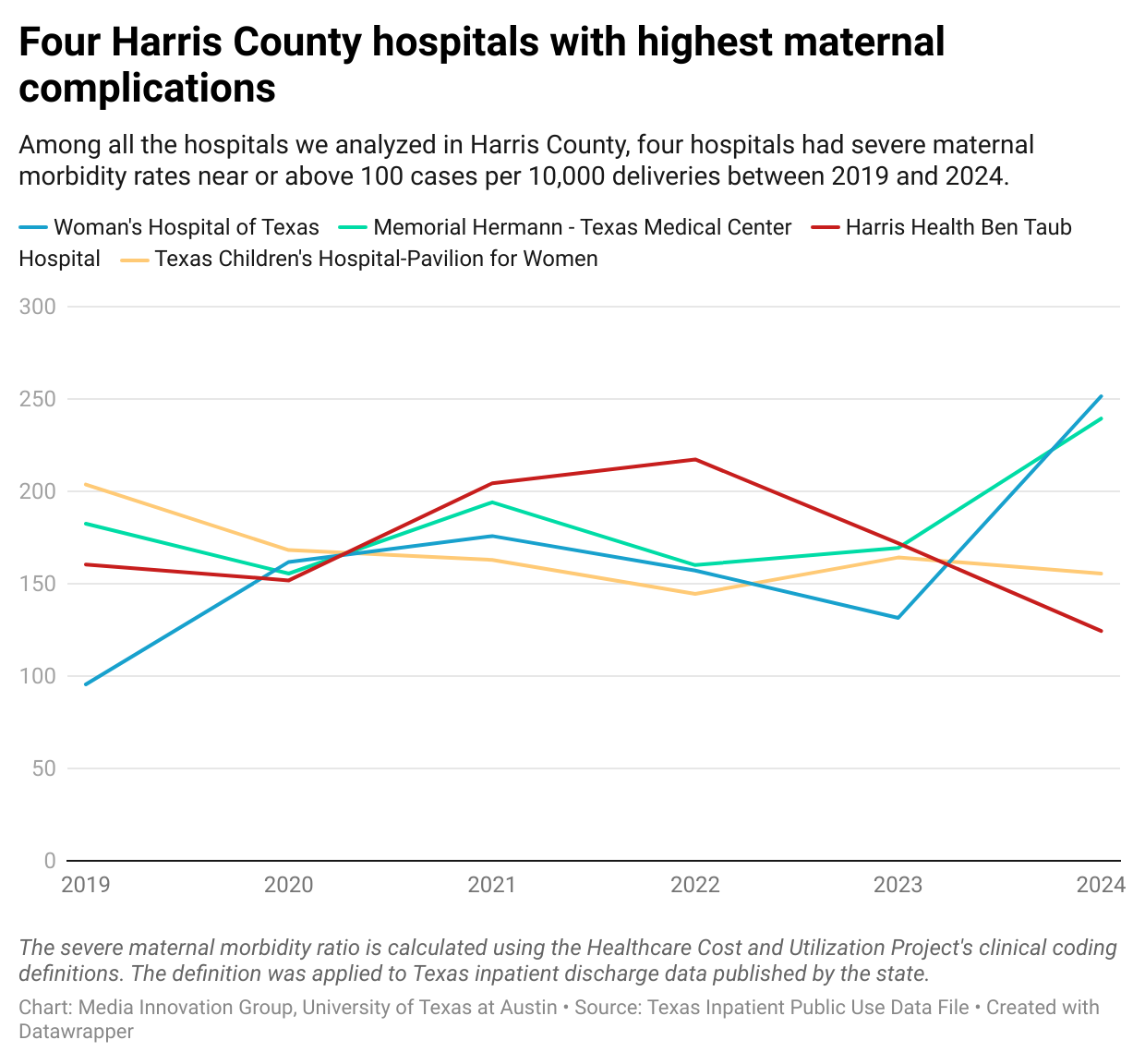
Our goal was to use the Texas Inpatient Public Use Data File and various industry quality measures to learn more about maternal health care in Texas hospitals. The principal measure we considered was a definition for “severe maternal morbidity” developed by the Healthcare Cost and Utilization Project (HCUP).
We also considered other Inpatient Quality Indicators as defined by the Agency for Healthcare Research and Quality (AHRQ): Primary Cesarean births and Vaginal Births After Cesarean.
Principals
- Principal analysis: Teresa Do, senior journalism student and data editor for the Media Innovation Group.
- Editor: Christian McDonald, associate professor of practice and director for the Dallas Morning News Journalism Innovation endowment.
The Media Innovation Group is an experiential learning project in the School of Journalism and Media at the University of Texas at Austin. The work is funded by the Dallas Morning News Journalism Innovation Endowment at the Moody College of Communication.
About the data
Our main analysis centers around a definition of “severe maternal morbidity.” The state of Texas provides a severe maternal mortality dashboard that uses data sources beyond hospital inpatient data, but it does not provide statistics more detailed than a regional level.
In order to get to the hospital level, we used a definition outlined by the Healthcare Cost and Utilization Project (HCUP) designed for use with inpatient discharge data.1 Unlike with most other states, HCUP does not provide Texas inpatient data through their standardized distribution system, so we requested it directly from the Texas Department of State Health Services.
We’ve taken great care to follow standardized, evidence-based measures of healthcare quality by following respected published guidelines like HCUP and AHRQ. That said, there still may be small differences in our analysis and published statistics by those organizations. For instance, HCUP excludes patients treated in community hospitals that are long-term care facilities such as rehabilitation, psychiatric, and alcoholism and chemical dependency hospitals.2 We don’t exclude any hospitals in our statewide analysis. Our main intent is to drill down to specific hospitals in Harris County, where that difference is not a factor.
Takeaways
Written
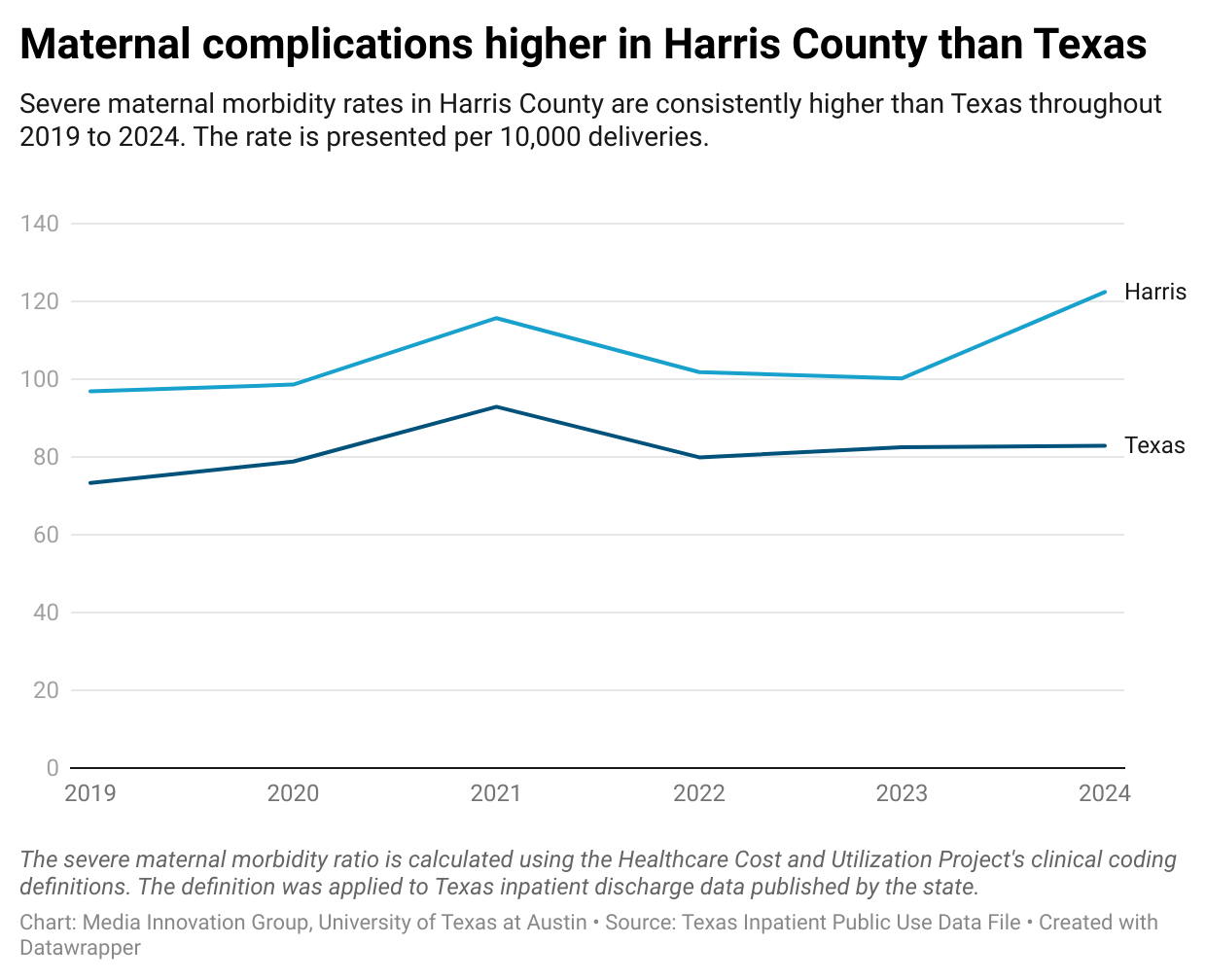
- The difference in severe maternal morbidity cases per 10,000 deliveries between Harris County and Texas floats around 20 deliveries from 2019 to 2023. The difference shoots up in 2024 to nearly 40 deliveries.
- Comparing 2019 and 2024, Harris County saw a 26.3% increase in the rate of severe maternal morbidity cases while Texas only saw a 0.5% increase.
Charts
Footnotes
We used the definition listed on the HCUP Fast Facts page under the heading “Clinical Coding Definitions”.↩︎
Details about these limits can be found in the HCUP Fast Facts page in the Notes section under the heading “In-Hospital Deliveries (Inpatient)”.↩︎